
TL;DR: You don’t need to be a musician to raise one — with the right environment, encouragement, and guidance, any parent can help their child fall in love with music.
Summary: Music education does far more than teach kids to play an instrument. It shapes the brain, builds confidence, and develops social and emotional skills that last a lifetime. The good news? Parents are the single most powerful influence in whether a child develops a lifelong relationship with music — and it starts way before the first lesson.
Explanation Paragraph: Study after study confirms that children who engage with music from an early age show stronger language skills, better memory, improved mathematical reasoning, and sharper problem-solving abilities. Music simultaneously stimulates multiple areas of the brain, building neural connections that support learning well beyond the music room. And here’s what surprises most parents: you don’t need to read sheet music or know how to play anything to get your child started. Exposure, enthusiasm, and the right environment are everything. When you’re ready to take it a step further, a music studio like this can be a great place to show kids about music — giving them access to professional instruments, trained teachers, and a space where music is taken seriously.
Why Music Matters More Than You Think
Music education is not a “nice extra” — it’s one of the most cognitively stimulating activities a child can engage in. Learning to play an instrument or even engage with music regularly strengthens memory, improves listening skills, and boosts problem-solving abilities by requiring the brain to make real-time adjustments. Children in music programs also develop stronger emotional intelligence, learning to interpret and express feelings in a structured, healthy way. Group music activities go even further — they teach teamwork, empathy, and communication, all skills that benefit kids in school and throughout life.
Beyond the social benefits, research shows that musical training creates near and far transfer effects in the brain, meaning the skills kids learn through music don’t stay in music — they carry over into language, reading, and even math. For parents wondering whether music lessons are “worth the investment,” the science says clearly: yes.
Start at Home — Building a Musical Environment
You don’t need a piano in the living room to raise a music-loving child. It starts with something much simpler: making music a part of daily life. Play a variety of genres throughout the day — classical in the morning, something upbeat during playtime, world music at dinner. Kids absorb far more than they let on, and consistent exposure builds an intuitive feel for rhythm, melody, and tone.
Sing together during everyday routines. Bath time, the school run, cooking dinner — all of these become opportunities. Something as simple as singing “Head, Shoulders, Knees and Toes” or making a shaker out of a plastic bottle with rice inside turns an ordinary moment into a music lesson. Provide simple instruments early: a small xylophone, a tambourine, a mini keyboard. Let kids bang on them, experiment, and make noise without correction. At this age, play is the lesson.
An Age-by-Age Guide to Music Introduction
Not every approach works for every age. Here’s a practical breakdown:
- Ages 0–5: Focus entirely on informal exposure — singing, clapping, dancing, nursery rhymes, and simple rhythm instruments. The Suzuki Method allows some children to begin structured learning as early as age 3 for instruments like violin and piano.
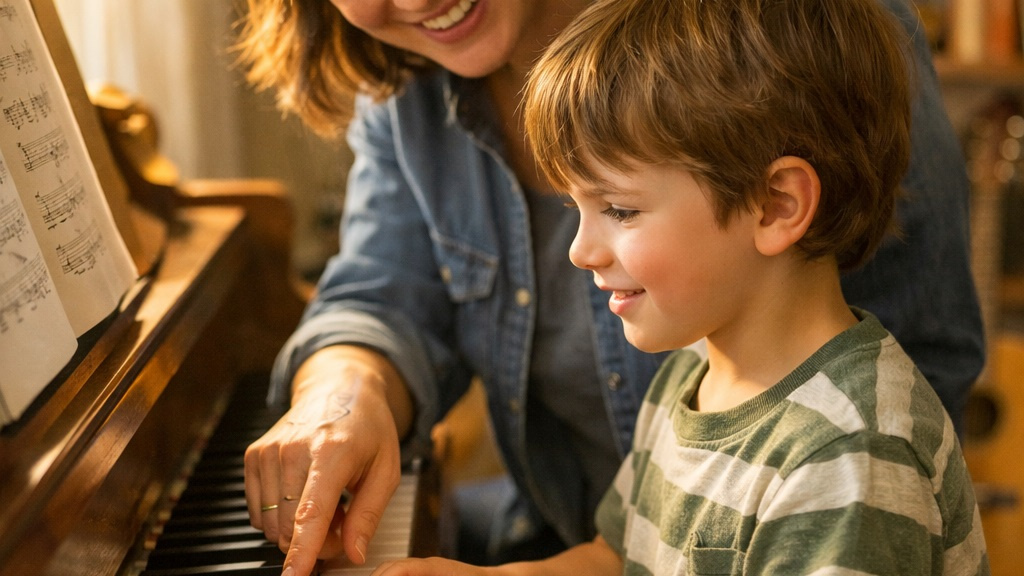
- Ages 5–7: This is the sweet spot for starting formal lessons. Most children at this stage have the finger strength, attention span, and basic literacy needed to follow structured instruction. Piano, guitar, ukulele, and recorder are ideal starting instruments.
- Ages 8–12: Kids can now advance to more complex instruments like cello, violin, or drums. This is also the right time to introduce music theory, set performance goals, and explore ensemble or group playing.
The key rule: readiness matters more than exact age. A curious, engaged five-year-old will outlearn a reluctant seven-year-old every time.
How to Support Without Pressuring
This is where most well-meaning parents struggle. The line between encouraging a child and pressuring them is thin — and crossing it can kill a child’s love of music faster than anything else.
Treat music practice like brushing teeth — consistent, non-negotiable, but not dramatic. For young beginners, 10 to 15 focused minutes every day beats a single exhausting 90-minute weekend session every time. Short, regular practice builds muscle memory and confidence far more effectively than marathon cramming. Celebrate small wins: finishing a tricky section, memorizing a new chord, playing something from start to finish without stopping. These moments matter enormously to a child.
Let your child lead instrument choices. If they start on piano but become fascinated with drums, follow that interest. Forcing them to stick with an instrument they’ve grown to resent is the fastest route to quitting altogether. Ask their teacher for specific at-home practice strategies — a good music teacher will tell you exactly how to make practice work for your child’s age and temperament.
When to Get a Professional Involved
At some point, home encouragement isn’t enough on its own — and that’s completely normal. A qualified music teacher provides what no parent can: structured technique, expert feedback, and a progression plan that prevents bad habits from forming early.
When choosing a teacher, look specifically for someone who works with children regularly. Teaching music to a seven-year-old requires a completely different skillset than teaching a teenager or adult. Beyond lessons, exposing kids to live music — concerts, school performances, or local music events — is enormously powerful. Kids learn through observation and imitation, and seeing real musicians at work plants a seed that no lesson can.
Making Practice Fun — Tips That Actually Work
The goal at every stage is the same: keep music feeling like something they want to do, not something they have to do.
- Let kids choose at least one song they love for every practice session
- Use musical games like Freeze Dance, musical chairs, or clapping rhythm challenges
- Set up a dedicated “music corner” at home with their instrument always accessible and ready
- Record short performances and play them back — kids love hearing themselves improve
- Attend recitals and concerts together and frame it as a fun family outing
- Connect music to things they already love: their favourite film soundtrack, a TV show theme, a song from a game
Key Takeaways
- Early, informal exposure to music at home — through singing, dancing, and simple instruments — builds a foundation before any formal lesson begins.
- Ages 5–7 is the most widely recommended window for starting structured music lessons, though musical exposure should begin from birth.
- Short, consistent daily practice (10–15 minutes for young children) is far more effective than occasional long sessions.
- Parents don’t need to be musicians — enthusiasm, consistency, and a musical home environment are what matter most.
- Professional music education from a qualified teacher deepens technique, builds confidence, and gives children a structured path to real musical growth.
Frequently Asked Questions
What is the best age to start music lessons for kids?
Most music educators and researchers agree that ages 5–7 is the ideal window for beginning formal instrument lessons. At this stage, most children have developed the focus, finger coordination, and early reading ability needed to follow structured instruction. That said, informal exposure — singing, clapping, rhythm play — should begin from infancy. Some methods, like the Suzuki approach, introduce structured learning as early as age 3 for instruments like violin and piano. Rather than watching the calendar, watch your child: genuine curiosity and the ability to follow simple multi-step instructions are the real readiness signals.
How do I get my child interested in music without forcing it?
The most effective thing you can do is lead by example. Sing in the car, dance in the kitchen, put music on during everyday activities — let your child see that music brings you genuine joy. Before committing to an instrument, let them experiment freely with several options. Connecting music to things they already love — a favourite movie score, a song from a video game, a cartoon theme — makes the whole thing feel relevant rather than like homework. Celebrate effort and curiosity, never perfection. The love for music comes first; the skills follow naturally from there.
How much should my child practice music each day?
For beginners aged 5–8, 10 to 15 minutes of focused daily practice is genuinely enough. For children aged 8–12, gradually building toward 20–30 minutes per day is appropriate. The keyword is daily — consistency beats duration every single time when it comes to building musical skill and memory. Practice should feel engaging, not punishing. Work with your child’s teacher to set realistic, age-appropriate goals for each session, and let progress — not the clock — guide when to stop.